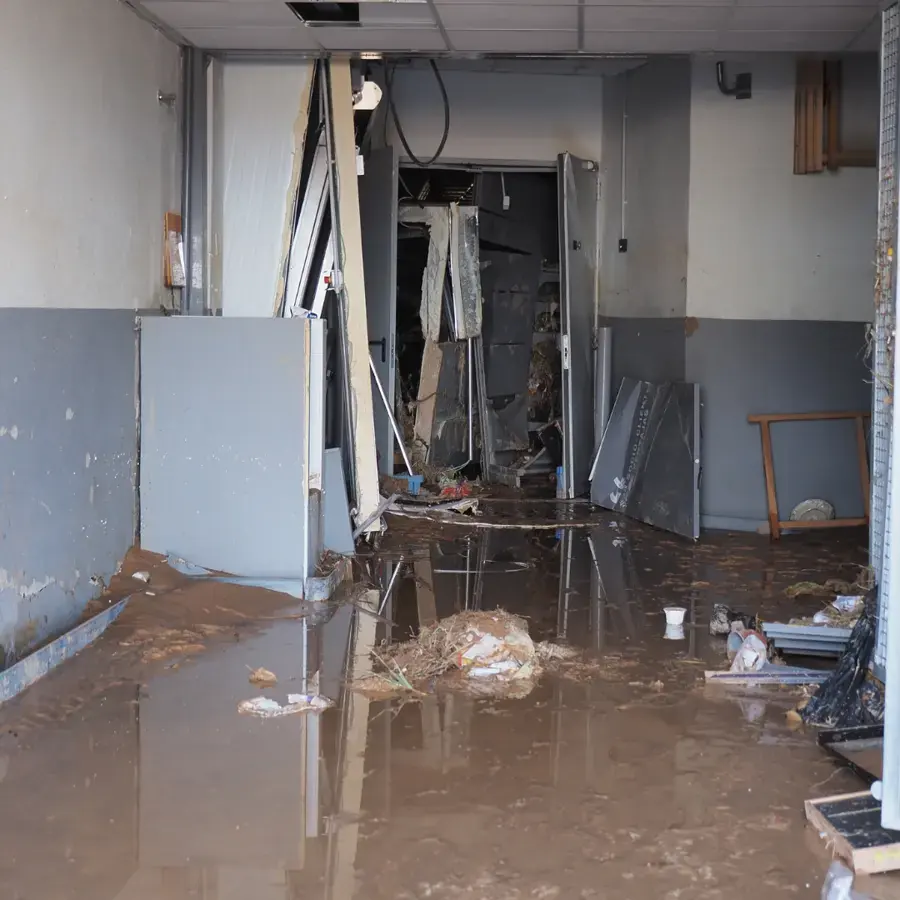
Heavy rain does not need long to fill a lower level. This post uses the July 2019 storm to show how fast water arrives in Herndon, Virginia, where the town's creek watersheds fit into the picture, and what a basement flooding cleanup actually does.
Key takeaways
- On July 8, 2019, a severe storm brought flash flooding across the Washington, D.C. region, with up to 5.5 inches of rain in about 3 hours reported in Fairfax County.
- Herndon sits on the border between the Sugarland Run and Horsepen Creek watersheds.
- The Town of Herndon restored about 2,000 feet of Sugarland Run to decrease flood impacts.
- Water that entered from outside is handled as contaminated, so wet materials are removed with care.
- Drying is finished only when moisture readings return to normal.
The July 8, 2019 storm
On July 8, 2019, a severe storm brought flash flooding across the Washington, D.C. region. The Fairfax County hazard mitigation annex records up to 5.5 inches of rain within a 3 hour period in Fairfax County.
That is the kind of rain a drainage system is not built to ignore. It shows how little time lies between a dry day and a wet lower level.
The county report does not say which Herndon homes were hit, and this post does not claim any. It uses the storm as a measure of how intense rain can become.
Where Herndon sits among the creeks
Fairfax County describes the Town of Herndon as on the border between the Sugarland Run and Horsepen Creek watersheds.
That means rain across town has more than one route to a creek, and a heavy downpour can send water toward houses before it gets there.
Herndon is the largest of the three incorporated towns in Fairfax County, Virginia, with 24,655 people at the 2020 Census.
Downtown Herndon is centered on Elden Street, Lynn Street and Station Street near the depot and the W&OD trail. The town also has its own police department and an elected Mayor and Town Council.
What the town did on Sugarland Run
The Town of Herndon's Sugarland Run Stream Restoration project restores about 2,000 feet of steep, degraded stream. The goal is to improve water quality and decrease flood impacts.
The project includes a stretch near the W&OD Trail crossing.
Stream work helps the creek, and it does not remove the chance of water entering a house in a heavy storm. A lower level still has to be ready for it.
Neighborhoods across the area, from Downtown Herndon to Sugarland Heights and Herndon Heights, face the same weather even though their homes differ.
It helps to remember that Herndon provides its own water and sewer to town residents and buys its drinking water from Fairfax Water. A flooded lower level after rain is a property problem, not a water supply problem.
How water gets into a lower level
Rain finds the lowest route. In a downpour that route is often through a window well, a door threshold or the junction of floor and wall.
Herndon has homes of many ages, from buildings dating to the 1700s and others built between the mid 1800s and the early 1900s to later neighborhoods. The same rain meets all of them.
Surface runoff
Water running across a yard collects against the house. If the grade slopes toward the foundation, the water follows.
- Check that gutters and downspouts carry water away.
- Clear window wells of leaves and debris.
- Notice low spots where water pools after rain.
Water that comes up from below
When the ground is full, water pushes through cracks and the seam where the floor meets the wall. This often shows as dampness first and standing water later.
What a flooded lower level needs first
The first priority is safety. Stay out of rooms where water reaches outlets, the panel or appliances.
Then slow the damage. The longer carpet and drywall sit wet, the more they absorb.
Do not try to carry soaked furniture alone through standing water. Wait until power to the area is safe and the water level is known.
- Have power to the wet area shut off by someone who can do it safely.
- Move furniture and boxes out of the water.
- Photograph the water level and the damage.
- Call a restoration team to start extraction.
How the cleanup works
A basement flooding cleanup starts with extraction. Truck mounted and portable extractors pull standing water from carpet, pad and floor.
Water that came from outside is treated as contaminated. Wet pad and flooring are removed, and drywall is cut where moisture has traveled.
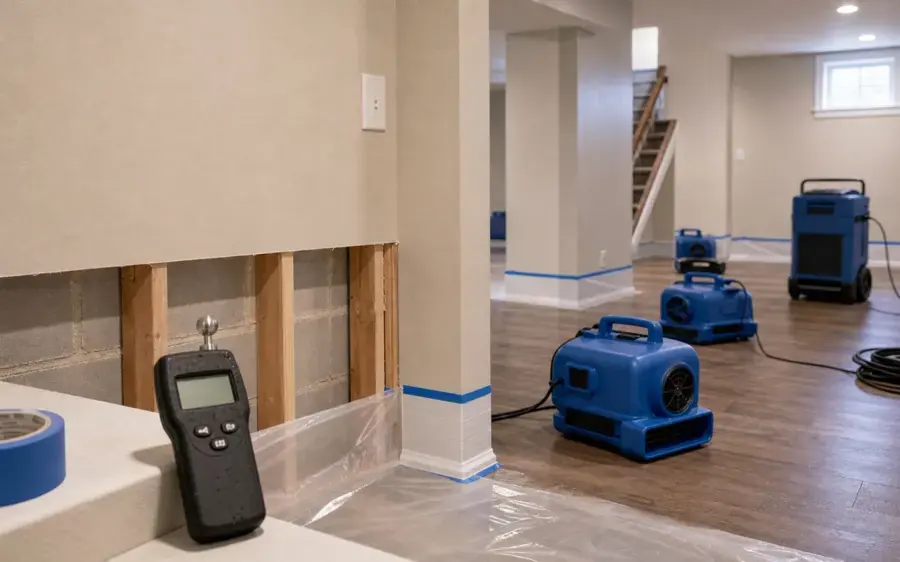
Then drying begins. Air movers and dehumidifiers run until moisture meters and a thermal camera show the structure is back to normal readings.
A town of 7,900 households has plenty of townhome and condo communities where shared walls and floors matter. In those buildings, drying includes readings in neighboring spaces.
- Extract standing water.
- Remove materials that cannot be saved.
- Clean and treat the surfaces the water touched.
- Dry the structure to readings and document them.
Storm water as a bigger event
Sometimes the water is not just in one room. Storm and flash flood cleanup covers floods that reach several rooms or levels.
Whether the water is in one corner or across the lower level, the sequence is the same: extract, remove, clean, dry and document. The Herndon water damage page lists the other problems the team handles in town.
Each step produces a record. That record is useful for the insurance claim and for the next time rain tests the same space.
The town also flushes its water mains each spring by opening fire hydrants for a short period. That is a water supply task, and it has no bearing on rain water entering a lower level.
Questions
How much rain fell in the July 2019 storm?
The Fairfax County hazard mitigation annex records up to 5.5 inches of rain within a 3 hour period in Fairfax County in the July 2019 storm.
Which watersheds is Herndon between?
Fairfax County describes the Town of Herndon as on the border between the Sugarland Run and Horsepen Creek watersheds.
Did the town work on flood impacts?
The Town of Herndon's Sugarland Run Stream Restoration project restores about 2,000 feet of stream to improve water quality and decrease flood impacts.
Is storm water in a basement clean?
Not reliably. Water from outside can carry soil and contaminants, so wet materials are removed with care and surfaces are treated.
How do I know my lower level is dry?
Moisture meters give readings in the floor, walls and framing. The work is finished when the readings return to normal.
Does Herndon run its own water and sewer?
Yes. The Town of Herndon provides water and sewer service to town residents, and it purchases its drinking water from Fairfax Water.