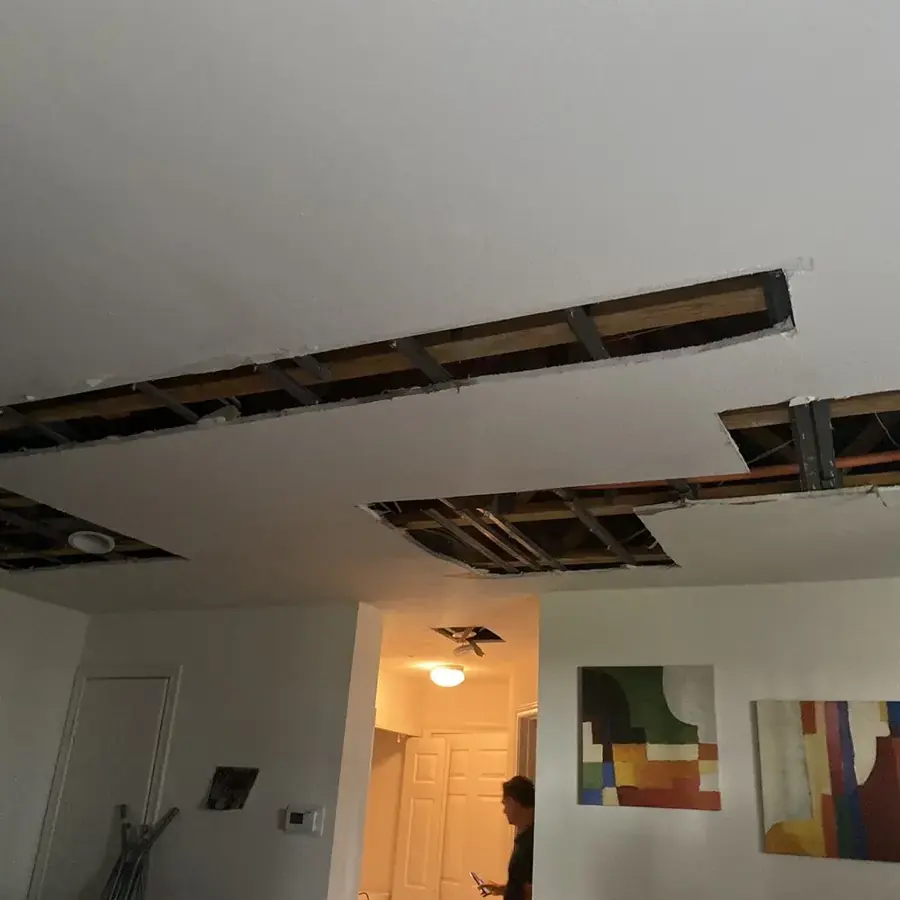
In a townhome or condo, a ceiling stain often starts with something happening in a room above. Germantown and Gaithersburg both have many homes that share walls and floors, and this post explains how a leak is traced, opened and dried.
Key takeaways
- Germantown has many townhouses and garden condos, and Gaithersburg has townhome and condo communities such as Kentlands and Lakelands, so shared walls and floors are common.
- In multi unit buildings and townhomes, a leak from the floor above shows up first as a ceiling stain.
- The source is traced first, because drying a ceiling while the leak continues achieves nothing.
- Wet drywall is opened safely and the joist bays above it are dried with air movers and dehumidifiers.
- Neighboring spaces are checked with moisture readings, because water rarely stays in one room.
Why ceilings tell the story first
Water falls and spreads. A leak in an upstairs bathroom or a unit above travels along floor framing and then drops through the ceiling below.
The ceiling is usually the first place anyone notices. By then the water has already moved through the floor system above it.
In a single family house, the stain is the owner's alone to solve. In a townhome or condo, it is shared with neighbors and sometimes an association.
Shared walls in Germantown and Gaithersburg
Germantown has many townhouses and garden condos along the I-270 corridor. Gaithersburg has many townhome and condo communities, among them Kentlands and Lakelands.
In those buildings, one failure can reach neighboring spaces. That raises the stakes beyond a single stained ceiling.
Both cities are served by WSSC Water, but a leak inside a building belongs to the owner or the association, depending on where it starts.
That shared structure is why local conditions matter. Homes built along the I-270 corridor often stack bathrooms and kitchens over each other.
Stacked rooms mean stacked plumbing, so one failed fitting can touch the ceiling of the room below and sometimes the unit beside it. It is also the reason a small stain deserves a closer look than it first appears to need.
Where ceiling leaks come from
The source decides who needs to act. Common starting points are the same in both cities.
Not every leak is a plumbing failure. A little detective work saves a lot of unnecessary opening.
Condensation on a cold pipe, a clogged drain pan under an air handler or a window that leaks during storms can all mimic a plumbing failure. Each leaves a stain that looks the same from below.
Timing offers a clue. A stain that grows only during rain points toward the roof or an exterior wall, while one that grows when a shower or washer runs points toward plumbing above.
- Stain grows only after rain: look at the roof, flashing and exterior walls.
- Stain grows when the unit above runs water: look at plumbing and appliances.
- Stain stays the same size and feels dry: it may be an old leak, which still needs checking.
Plumbing above
A bathroom supply pipe, a toilet connection or a tub drain can leak above a ceiling. The water follows pipes and framing before it drops.
- Supply hoses and shutoff valves.
- Toilet and tub connections.
- Drain pipes that sweat or loosen.
Appliances above
A washer or dishwasher in the unit above can leak for a long time before the stain appears below.
- Hoses behind washers and dishwashers.
- Refrigerator ice maker tubing.
Roof and exterior
Some ceiling leaks come from the roof or an exterior wall. These look similar and are traced differently.
First steps when a ceiling stains
Stop further damage and gather facts. The order matters.
If the stain is wet and growing, assume water is still coming.
Do not poke a bulging ceiling with a screwdriver or a broom. Water can pour out suddenly, and the drywall may fall with it.
Protect the floor below as well. Cover furniture with plastic and roll up rugs, because a ceiling that finally gives way drops wet drywall and insulation all at once.
- Shut off the water to the suspected source if you can reach it.
- Place a container under any drips and move belongings away.
- Stay out from under a bulging or sagging ceiling.
- Photograph the stain and note when it first appeared.
- Notify the owner above or the association, since the source may be theirs.
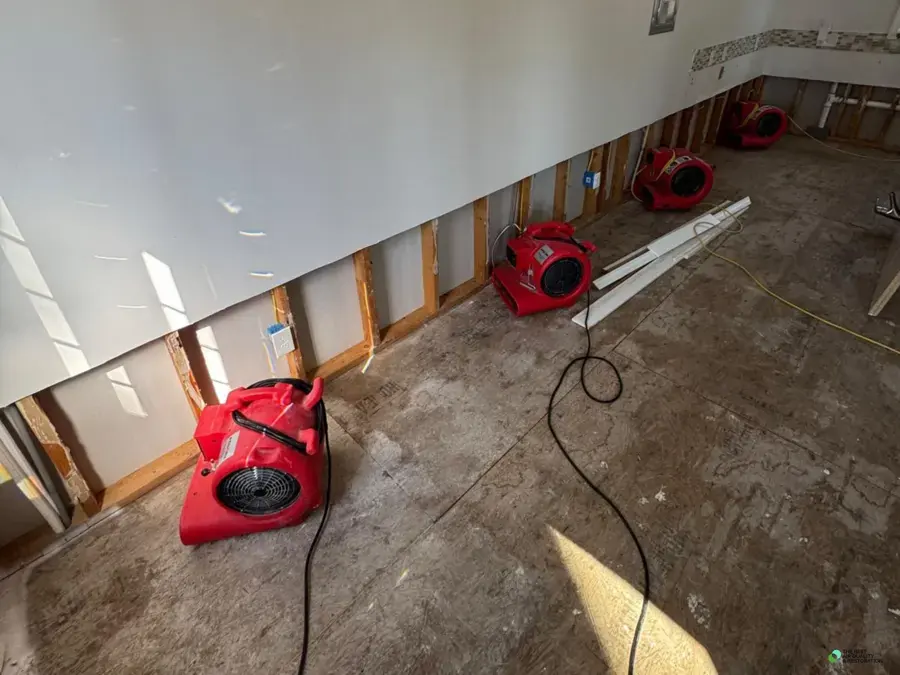
How the source is traced and the ceiling opened
Tracing comes before drying. A moisture meter and a thermal camera follow the water to its origin.
A ceiling leak water damage job then opens the wet drywall safely. The crew cuts only where readings show water, to limit the repair afterward.
In Gaithersburg the same work is done through the ceiling leak service in Gaithersburg, with the same steps.
Tracing before cutting protects the repair budget. Smaller openings are easier to patch and paint.
- Meters and a thermal camera map the wet area.
- Drywall is opened where readings call for it.
- Wet insulation is removed.
- The source is identified so it can be repaired.
Drying the joist bays and neighboring spaces
Opening the ceiling exposes the joist bays, which are the spaces between floor framing. They hold water long after the surface looks dry.
Air movers and dehumidifiers dry the framing and the room. Readings are taken each visit and at the end.
Shared walls mean neighboring spaces are checked too. Structural drying follows the water into every area it reached.
Insulation inside the joist bays is removed when it is wet, because it holds water against the framing.
Working with neighbors and the association
In a townhome community, a leak can involve more than one household and an association. Clear records help everyone.
The Gaithersburg water damage page lists related problems the team handles in town.
A tidy file of dates, photographs and readings turns a stressful event into a clear claim.
If the neighbor above is not home, leave a written note with the date and what was found. A clear record of the first notice helps the later conversation stay calm and factual.
- Keep photographs of every affected room.
- Save the moisture readings from the restoration team.
- Share dates and findings with the owner above and the insurer.
Questions
Why does my ceiling stain show up before I see any leak?
Water travels along floor framing and drops where it finds a gap. The ceiling is often the first place it appears.
Who is responsible when a leak comes from the unit above?
It depends on where the leak starts. Notify the owner above and the association, and keep records for insurance.
Will the whole ceiling need to come down?
Not usually. Drywall is cut only where moisture readings show water, and the rest is dried in place.
How do you know the source of the leak?
A moisture meter and a thermal camera follow the wet area back toward its origin, so the source can be found before drying.
Can neighboring rooms be affected?
Yes. Water moves through framing and shared walls, so neighboring spaces are checked with readings.
Why does the stain change size?
A stain grows when water keeps moving through the framing and shrinks only as the surface dries. A stain that looks stable can still hide wet framing above, which readings will show.
Why should I not poke a bulging ceiling?
A ceiling that bulges is holding water, and it can release it suddenly or fall. A trained crew opens it in a controlled way and dries what is behind it.