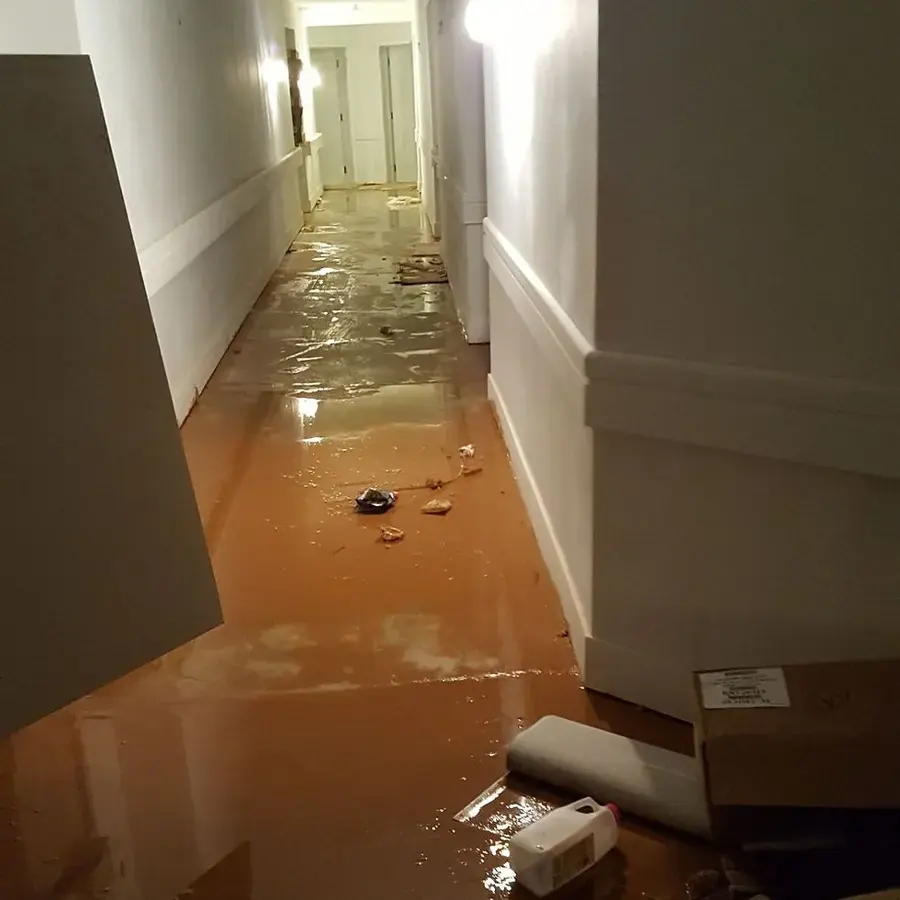
Poolesville sits among small creeks, and heavy rain gives them somewhere to go. This post looks at how runoff from those creek watersheds reaches a house, why the town's own water system has nothing to do with it, and how a wet lower level is dried.
Key takeaways
- Poolesville consists of four watersheds: Horsepen Branch, Broad Run, Dry Seneca Creek and Russell Branch.
- In December 1996, Seneca Creek flooded state route 28 southeast of Poolesville after near record rain, a reminder of what creek water can do.
- The Town of Poolesville runs its own water and sewer and pumps drinking water from 12 wells, so a wet basement is a drainage problem and not a supply problem.
- Storm and creek water is treated as contaminated, so wet materials are removed more carefully than after a clean leak.
- Moisture readings, not appearance, decide when a lower level is dry.
Four small watersheds around town
Poolesville consists of four watersheds: Horsepen Branch, Broad Run, Dry Seneca Creek and Russell Branch. Each one carries rain toward a creek.
The town's wastewater treatment plant sits near Dry Seneca Creek. That puts the creek in the town's daily story as well as its stormy one.
Poolesville is in the western part of Montgomery County and is surrounded by, but not part of, the Montgomery County Agricultural Reserve. Open land around town sends runoff toward those creeks.
Poolesville lies off the main Interstate 270 and MD 355 suburban corridor, where new housing and commercial starts are restricted in the Agricultural Reserve. The result is a town that stays small and keeps open land close by.
What December 1996 showed
In December 1996, Seneca Creek flooded state route 28 southeast of Poolesville after near record rain.
It is one dated event, and it is not a flood of any particular neighborhood. It does show that creek water in this part of Montgomery County can leave its banks.
A creek that climbs in one storm can climb again in the next. Each event is a reminder to keep drains clear and know the plan before rain arrives.
- The event involved a road southeast of town and not a specific house.
- It shows how rain on the creeks can outrun the ground's ability to take it.
- It is a reason to plan for storm water and not a prediction for any one street.
How runoff reaches a house
Runoff does not need a flood to cause trouble. A heavy downpour can saturate the ground around a foundation and push water in through window wells, doors and cracks.
Homes with a basement or a low level feel it first. A ground level room can see the same water through a threshold.
Housing in town grows slowly. Ferry Crossing, next to Town Hall, was approved in early 2023 with 63 small single family homes, while older homes have settled in their own ways.
The same rain meets both.
Runoff against the foundation
Water that cannot soak in moves downhill, and a house often sits in its path. It collects at the lowest point and finds a way in.
Creek water over a low spot
Creek side yards can take water when the creek rises. That water carries mud and whatever the creek bank held.
- Check low spots and window wells during heavy rain.
- Keep gutter discharge pointed away from the house.
- Know where the main water shutoff is.
A wet basement is not a water supply problem
The Town of Poolesville owns and runs its own water and sewer systems, and WSSC Water does not serve the town. All drinking water comes from groundwater pumped from 12 wells.
None of that changes what happens when rain finds a way into a house. A wet lower level after a storm is a drainage problem on the property.
Town water and sewer operators respond to main sewer clogs and water main breaks. Storm water in a lower level is cleaned up by the owner with a restoration team.
The distinction helps with the first phone call. A broken town main goes to the town's water and sewer operators, and rain water in a lower level goes to a restoration team.
Storm and creek water is treated as contaminated
Water that came from outside carries soil, debris and whatever it crossed. That is why storm and flood cleanup is different from drying a clean pipe leak.
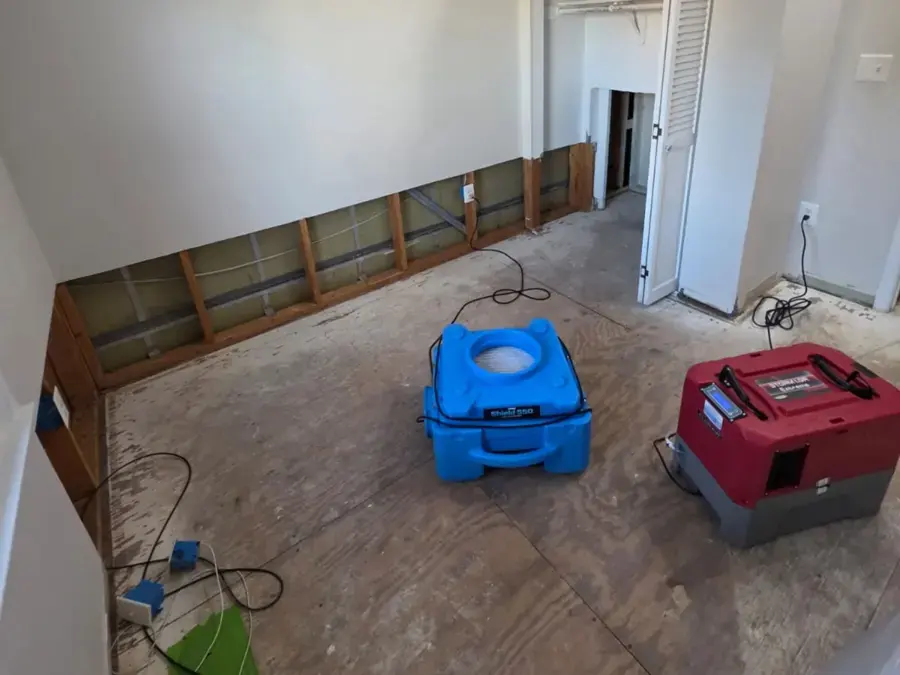
Wet carpet and pad are usually removed, and drywall is cut where moisture has traveled. Hard surfaces are cleaned and treated.
The work removes the water and the material it spoiled, and then dries what is left.
Because the water comes from outside, the crew does not take chances with materials that touched it. Anything that cannot be cleaned is removed.
- Standing water is extracted first.
- Soaked pad, flooring and drywall are removed where they cannot be saved.
- Surfaces the water touched are cleaned and treated.
- The structure is dried until readings return to normal.
How a lower level is dried
After extraction, air movers push air across wet surfaces and dehumidifiers pull moisture out of the room. This stage runs until readings, not a guess, say the structure is dry.
Moisture meters and a thermal camera show how far the water traveled into framing and subfloor. The crew opens only where the readings say.
A full basement flooding cleanup ends with documentation: readings taken at the start and at the end.
Drying is where many do it yourself efforts stall. A fan and an open window help the air, but they do not tell anyone what the framing holds.
After the storm: what owners can do
The first steps are about safety and about slowing the damage while help is on the way.
Planning ahead takes only a short list of tasks done before the wet season starts.
- Stay out of rooms with water near outlets or the electrical panel.
- Move furniture and valuables out of the water.
- Photograph the water level and what it touched.
- Call a restoration team before carpet and drywall absorb more water.
- Check the Poolesville water damage page for the other problems the team handles in town.
Questions
Which creeks affect Poolesville?
Poolesville consists of four watersheds: Horsepen Branch, Broad Run, Dry Seneca Creek and Russell Branch. Seneca Creek also flooded state route 28 southeast of town in December 1996.
Does Poolesville get its water from WSSC Water?
No. The Town of Poolesville runs its own water and sewer, and its drinking water comes from groundwater pumped from 12 wells.
Is creek or storm water clean?
Not reliably. It can carry soil, debris and contaminants, so the cleanup removes wet materials more carefully than after a clean leak.
Who handles the problem when storm water enters my basement?
The owner handles it with a restoration team. The town's water and sewer operators respond to main sewer clogs and water main breaks.
How do I know the lower level is dry?
Moisture meters give readings in framing, subfloor and drywall. The job is finished when the readings return to normal.
Does the September 2004 tornado have anything to do with basement water?
It is a separate event. An F1 tornado touched down near Poolesville on September 17, 2004, and it shows that severe weather does reach the town, but it is a wind story and not a creek story.